Training Drills That Prepare Volunteer Teams for Real-World Emergencies
When an emergency unfolds, volunteers may need to share accurate information, follow an incident command structure, and support residents without exceeding their training or authority. Regular practice helps teams build those habits before a real incident, but no drill can guarantee readiness. The value comes from realistic objectives, clear safety boundaries, and honest follow-through.
A useful training program combines discussion-based tabletop exercises with hands-on scenario-based drills. Both should reflect the local emergency operations plan, the volunteer team’s assigned roles, and guidance from relevant authorities. The goal is to practice decisions and coordination, not to imitate danger for its own sake.
Start with clear training goals and safety boundaries
Set one or two specific goals for each drill, then match the scenario to volunteer roles, experience, and approved procedures. Clear objectives and safety limits let participants practice useful skills without being asked to take on tasks they are not trained or authorized to perform.
Before choosing an exercise, review the team’s emergency operations plan and confirm how volunteers fit into local response arrangements. A neighborhood support group, for example, might practice checking in at a designated site, reporting a blocked route, or directing residents to official information. It should not simulate technical rescue or medical treatment unless the team is qualified and authorized to do so.
- Choose observable objectives: For example, every participant can state their assignment, identify whom to report to, and pass a clear hazard report.
- Set safety protocols: Name a safety lead, define stop-work language, identify physical boundaries, and explain how to handle a real emergency during the exercise.
- Assign roles: Clarify who facilitates, observes, communicates, and participates. Tell everyone how to pause or leave the drill.
- Scale the challenge: Add uncertainty through changing information or time pressure, not unsafe conditions or surprise physical hazards.
Use a short briefing to explain what is simulated and what is real. A realistic exercise still needs informed participants, accessible options, and a way to opt out of a task. Choosing more realism means accepting greater planning demands, so increase complexity only when the team can manage it safely.
Use tabletop exercises to rehearse decisions
A tabletop exercise lets volunteers talk through a simulated emergency without deploying people or equipment. It is a practical way to test decisions, role assignments, and coordination against the emergency operations plan before adding the demands of a field drill.
Start with a simple situation relevant to your community, such as a power outage that affects a community center or a storm that prompts an evacuation advisory. A facilitator introduces information in stages. Participants explain what they would do, who they would contact, and what information they still need. For example, a new report of a blocked access road can prompt the group to identify who records it, who informs the designated contact, and how the update reaches volunteers who are already deployed.
Keep the discussion grounded in actual authority. If participants are unsure whether a decision belongs to the volunteer team or an agency partner, note the question rather than inventing permission. The FEMA Incident Command System resources provide background on ICS principles and training materials; teams should follow the system and procedures adopted by their local authorities.
Tabletops are inexpensive and easy to pause, but they cannot reveal every practical problem. A group may describe a clear radio message yet struggle to deliver one over a noisy channel. Record assumptions and questions so later hands-on drills can test them.
Run scenario-based drills for hands-on skills
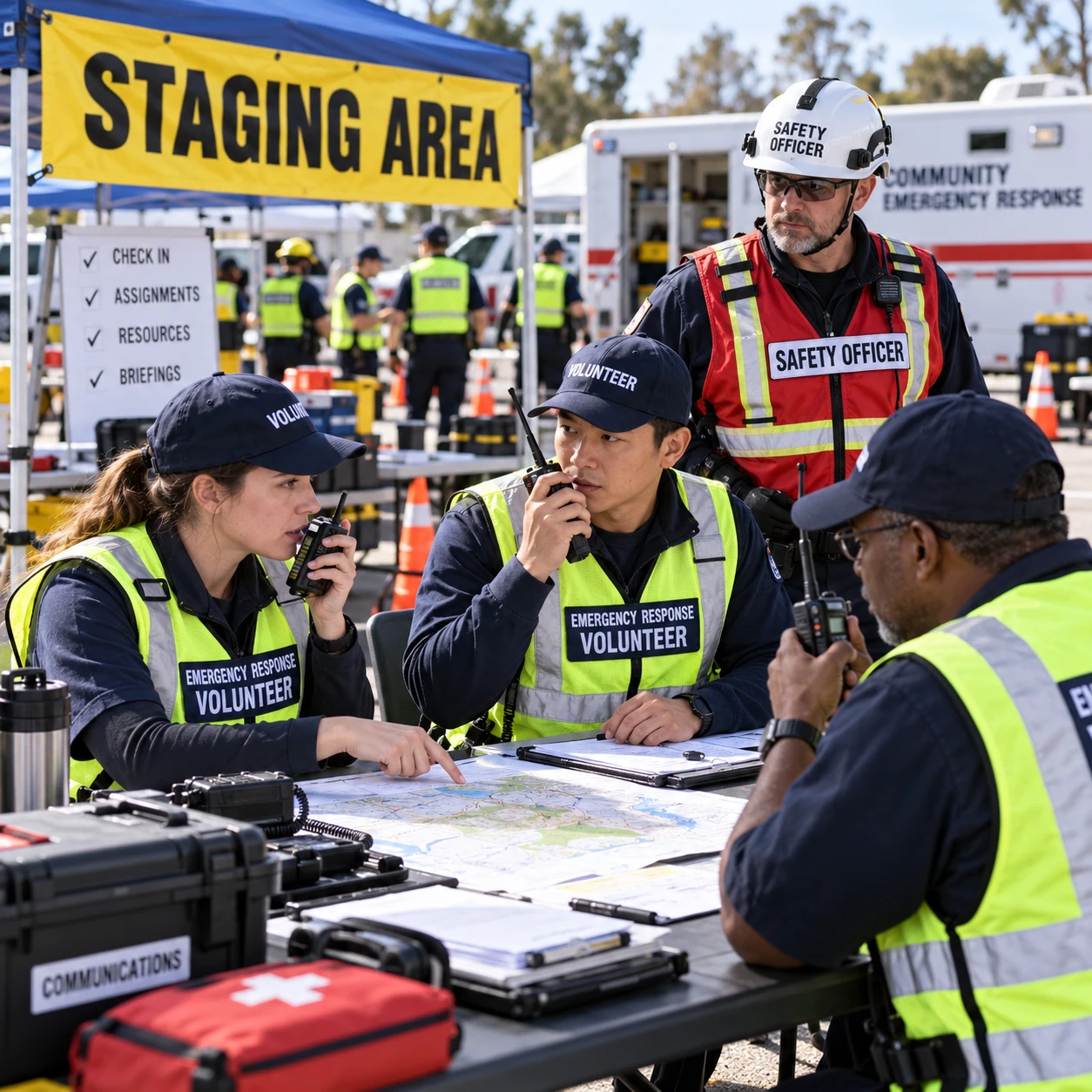
Scenario-based drills let volunteers practice specific tasks in a controlled setting. Choose activities that fit the team’s approved mission, such as reporting hazards, setting up a staging area, or supporting an evacuation under direction.
Keep the exercise narrow enough for observers to assess. In a staging-area drill, participants might check in, confirm their role assignments, locate the information point, and learn how to report a concern. In an evacuation-support scenario, volunteers can practice sharing an official route update and helping residents find the designated information source. They should not independently order an evacuation or enter unsafe areas.
Before starting, inspect the site, explain boundaries, and make sure props or simulated hazards cannot be mistaken for real hazards by the public. Use an exercise controller to introduce updates and a safety lead to stop the activity if conditions change. Tell participants how to distinguish drill messages from real emergency communications.
Hands-on practice exposes equipment, access, and handoff problems that discussion may miss. It also takes more time and coordination, so start with a small area and a few objectives. Add complexity only after the basic sequence is safe and understandable.
Practice communication and incident coordination
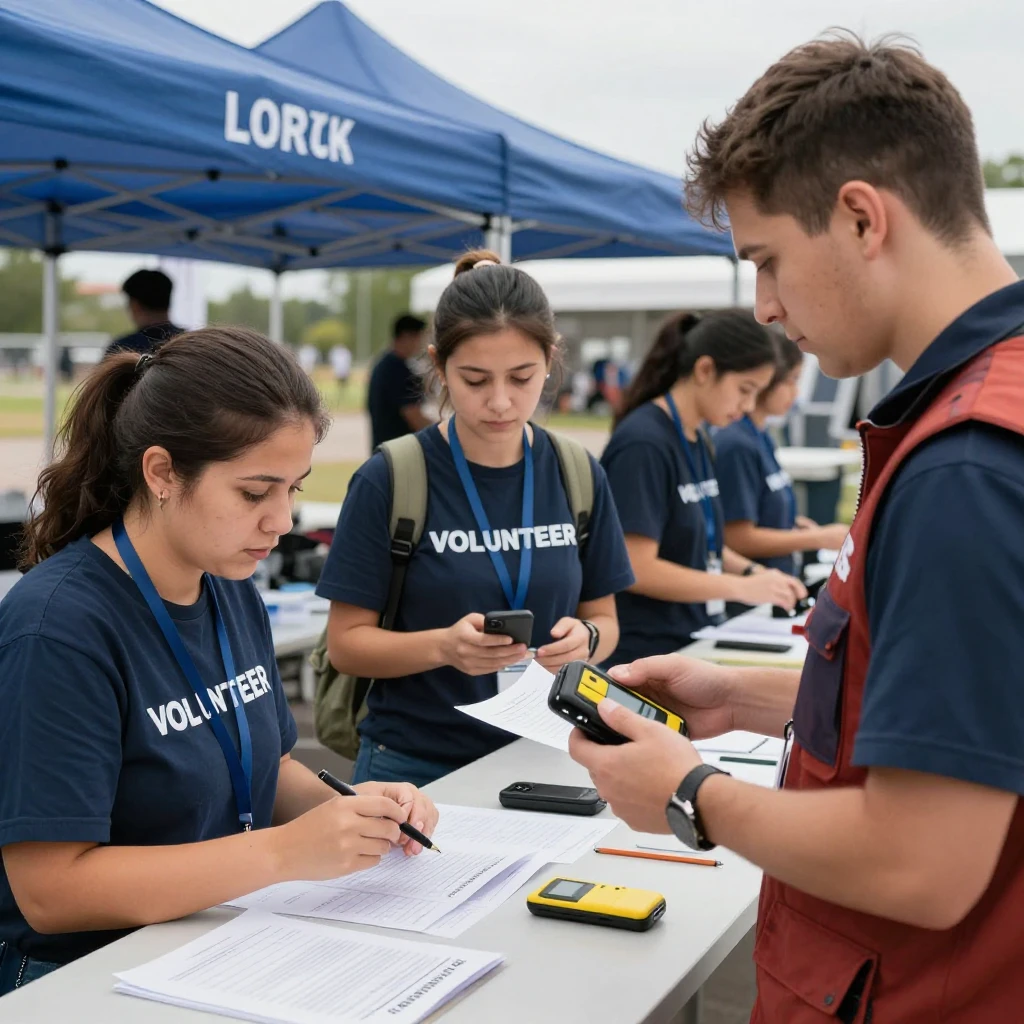
Practice communication by rehearsing concise radio reports, role handoffs, and the flow of information through the incident command system (ICS). Volunteers need to know whom to contact, what details to share, and how to confirm that a message was received.
Use a simple reporting pattern: identify yourself and your location, state the observed issue, give relevant details, and request or confirm the next step. A report such as “Team Two at the east entrance: the marked route is blocked by debris; we are holding at the safe boundary and notifying our supervisor” is more useful than a vague call that says only “We have a problem.” Teams should use local radio procedures and approved channels, not assume one format applies everywhere.
Build short communication tests into other exercises. Try a role handoff when a volunteer’s shift ends, or have the facilitator provide an updated location that must reach the right team. Observers can note whether messages were clear, accurate, acknowledged, and sent through the proper chain. Avoid overloading the scenario with artificial radio traffic; the aim is to reveal gaps, not to create confusion for its own sake.
Volunteer coordination depends on predictable information flow. When a message is uncertain, participants should know how to request clarification rather than guess. A drill can show whether contact lists, check-in procedures, or role assignments need updating.
Scale scenarios for mixed-experience volunteer teams
Mixed-experience teams can train together by giving everyone a shared objective while adjusting task difficulty and support. New volunteers need clear instructions and practice with core procedures; experienced members can lead, coach, or observe without taking over every decision.
For example, in a check-in exercise, a new participant can practice confirming their name, assignment, and supervisor. A returning volunteer can manage the check-in flow, while another experienced member observes for missed steps. Rotate roles in later sessions so leadership does not depend on one person and newcomers get a path to build confidence.
Make participation accessible. Offer written instructions, a quiet observer role, or a non-radio assignment when appropriate. Check that the exercise site and tasks suit participants’ needs, while preserving the same safety rules for everyone. A short pre-brief can cover terms and procedures without giving away every scenario detail.
The trade-off is that a single scenario may feel too simple for veterans or too fast for beginners. Use staged injects: begin with the shared basics, then introduce an optional complication for participants who are ready. Keep the learning objective consistent, and never use experience level as a reason to assign someone work outside their training or authority.
Debrief, document, and improve
An after-action review turns a drill into a concrete improvement plan. Ask what was expected, what happened, why it happened, and what the team will change before the next exercise.
Hold the discussion soon after the activity, while details are fresh. Keep the tone focused on the process rather than blame. A useful review can cover:
- What worked: Which actions or communication methods helped the team meet its objectives?
- What got in the way: Were role assignments unclear, contact details outdated, or instructions hard to hear?
- What needs action: Name a person responsible for each follow-up, set a reasonable deadline, and identify how completion will be checked.
- What should change: Update a checklist, briefing, training plan, or proposed procedure through the proper approval process.
Document observations without turning them into unsupported judgments about individuals. If the team misses a handoff, for example, check whether the procedure was clear and whether participants had a chance to practice it. Then assign a short follow-up drill and confirm the change worked. A report that sits unread on a shared drive does little; a concise action log with owners and due dates is more likely to improve the next response.
How often should volunteer teams practice?
Set a schedule that matches the team’s responsibilities, local requirements, and volunteer availability. Short, regular refreshers can help maintain familiarity, while larger exercises may be planned less often. Revisit a skill after a procedure, roster, or communication method changes.
What is the difference between a tabletop exercise and a field drill?
A tabletop exercise rehearses decisions through guided discussion, usually without deploying people or resources. A field drill lets participants practice tasks in a physical setting. Tabletop exercises are easier to control; field drills reveal practical issues that discussion may miss.
How can teams make drills realistic without compromising safety?
Use relevant scenarios, credible updates, and clear role assignments, while keeping hazards simulated and boundaries explicit. Brief participants, name a safety lead, and stop the exercise if a real concern arises. Coordinate with local authorities when the drill could affect public spaces or emergency communications.
What should an after-action review include?
Include the exercise objectives, key observations, strengths, gaps, and specific follow-up actions. Assign an owner and deadline to each action, then check whether the change was completed and tested in later practice.