Crowdsourcing and Social Media in Disaster Response and Recovery
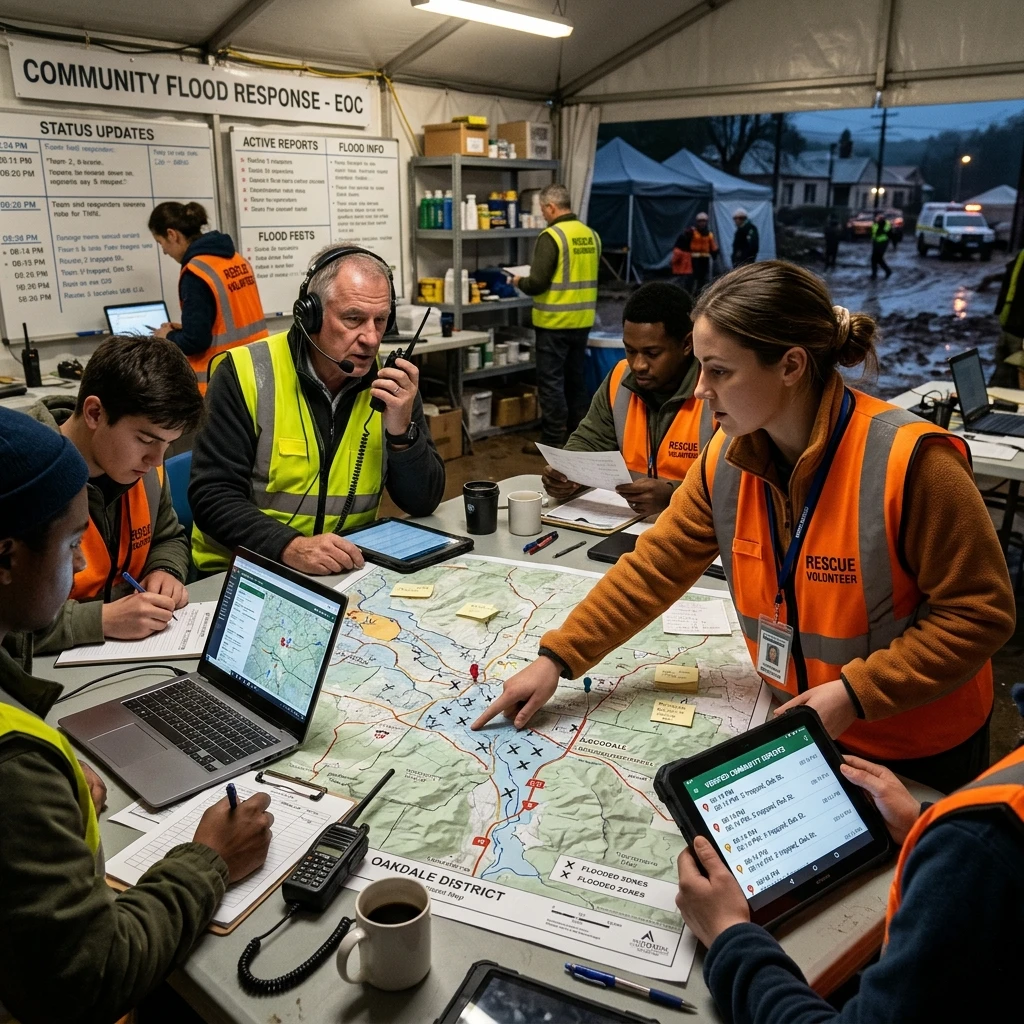
During a disaster, residents may share urgent needs, road closures, damage reports, and requests for help online before responders have a complete picture. Crowdsourcing and social media can help gather these observations and improve situational awareness, but only when information is checked, handled safely, and connected to an organized response.
For emergency response volunteers, the goal is practical: turn useful public information into a clear lead for an authorized organization. Online activity does not replace emergency services, official alerts, or trained field teams. It can, however, help those teams understand what is changing and where support may be needed.
How online participation supports disaster response
Online participation supports disaster response by collecting timely observations from affected communities and making patterns easier to see. Public posts, forms, messages, and shared photos can help responders identify changing needs, access problems, and reports that require follow-up.
During a fast-moving event, a single post may describe a blocked road or a household needing assistance. A stream of similar reports can reveal a broader issue, such as several neighborhoods losing power or a shelter nearing capacity. Volunteers may organize relevant reports into a crisis map or structured list, giving response teams a clearer view than an unfiltered social feed.
This process can strengthen situational awareness, the shared understanding of what is happening, where, and how conditions are changing. It works best when reports include a time, location, source, and clear description. Conditions can change quickly, so an accurate report from an hour ago may no longer be useful.
Social media platforms also give communities a way to ask questions and circulate official guidance. Yet reach is not the same as reliability. A widely shared post can still be wrong, incomplete, or out of date. Volunteers should treat online information as a lead to assess, not as confirmation that a need has been met or that an area is safe.
What emergency response volunteers can contribute
Emergency response volunteers can contribute by organizing reports, sharing verified alerts, and directing people to trusted resources. Their role should be clearly bounded: support the response with information and coordination rather than independently dispatching aid or making safety decisions.
Useful digital tasks include:
- Mapping reports: Record relevant, time-stamped observations such as impassable roads, damaged infrastructure, or requests for supplies in a format an authorized team can review.
- Sharing verified alerts: Repeat instructions from official emergency management agencies, public health departments, or recognized response organizations, preserving the original meaning and update time.
- Directing people to trusted resources: Help users find official evacuation information, shelter locations, reunification services, or established ways to request assistance.
- Sorting incoming information: Group reports by location or type of need, flag duplicates, and identify items requiring confirmation.
- Supporting accessible communication: Where trained and assigned, help make verified information available in relevant languages or accessible formats.
A volunteer might notice several public posts describing a bridge closure, compare the locations and timestamps, and send a concise summary to a designated coordination lead. The lead can then route it to the appropriate agency for confirmation. That handoff is more useful than posting a confident warning based on an incomplete report.
Choose tasks that match your training and the organization’s instructions. Digital volunteering can reduce information friction, but it cannot establish that a road is safe, conduct a rescue, or replace a request to emergency services.
From social media posts to usable information
To turn social media posts into usable information, gather relevant reports, assess their source and freshness, verify key details where possible, and relay them through an agreed channel. A simple sequence reduces the chance that an unconfirmed post will be mistaken for fact.
Use a consistent verification check
- Relevance: Does the report relate to an active response need, and can a team act on it?
- Source: Is the account identifiable, firsthand, or connected to a trusted organization? A verified badge alone does not prove a claim.
- Time and location: When was the observation made, and can the location be described precisely enough for follow-up?
- Corroboration: Do independent sources or an authorized organization support the report? Repeated copies of one original post are not independent confirmation.
- Safe relay: Can the information be shared without exposing someone’s identity, exact location, or sensitive circumstances?
Keep confirmed facts separate from unverified claims. Use labels such as “reported,” “awaiting confirmation,” or “confirmed by [organization]” only when the status is clear. Preserve the original timestamp, note any updates, and avoid editing a person’s words in a way that changes their meaning.
Information verification is a continuing process. If a report cannot be confirmed, pass it privately to the designated lead for assessment rather than broadcasting it as an alert. When a detail is no longer current, mark it outdated or remove it from an active map according to the team’s procedures.
Coordinating digital volunteers with on-the-ground teams
Digital volunteers coordinate effectively when they have defined roles, trusted communication channels, and a clear route for passing information to response organizations. Coordination helps prevent duplicate work and makes it more likely that online reports reach someone with the authority to act.
Before starting, find out who is supervising the digital effort, what information is needed, which platform or form to use, and how urgent reports should be escalated. Emergency management agencies, volunteer organizations, and incident coordination structures may set specific protocols. Follow those instructions rather than creating a separate reporting system during an active incident.
A useful handoff is brief and structured: what was reported, where and when it occurred, how it was checked, what remains uncertain, and how the team can follow up. Do not promise a rescue, delivery, or response time unless an authorized organization has confirmed it.
Clear roles also protect volunteers. A shift schedule, a point of contact, and a defined stopping time can reduce fatigue and make handovers safer. The trade-off is that a coordinated workflow may feel slower than reposting immediately; that pause can prevent confusion and help responders distinguish actionable information from rumor.
Risks and responsible participation
Responsible participation means checking information before sharing it, protecting affected people’s privacy, and staying within assigned roles. Crowdsourcing can surface important needs, but it can also amplify misinformation, reveal sensitive details, or create work that field teams cannot safely act on.
- Misinformation: Old images, mistaken locations, and unsupported claims can spread quickly. Check the original source and date, seek corroboration, and defer to official updates when they conflict with a social post.
- Privacy and safety: Do not publish names, phone numbers, medical details, identifiable images of people in distress, or precise locations that could expose someone to harm. Share sensitive information only through approved, secure channels.
- Volunteer safety: Do not enter hazardous areas or approach an incident to verify a post. Follow official safety guidance and your organization’s instructions.
- Duplication and overload: Several volunteers may investigate the same report, while responders receive the same message through multiple channels. Use a shared workflow and report only what your role requires.
One common mistake is treating a repost as verification. People do this because repetition feels like confirmation, but it may simply reflect one unverified source copied many times. Trace claims back to their origin and label uncertainty clearly.
Another mistake is posting identifiable images to prove that a need is real. That can expose someone without their consent and may compromise their safety. Share the minimum information needed, and use an authorized reporting channel for details that should not be public.
Finally, avoid direct, uncoordinated offers to deliver supplies or enter affected areas. Good intentions do not establish that a route is open or that a donation matches current needs. Check with recognized organizations before mobilizing people or resources.
Supporting recovery after the immediate emergency
Crowdsourced information can support disaster recovery by helping organizations and communities track ongoing needs after immediate life-safety operations. Reports about temporary housing, cleanup, inaccessible services, or unmet supply needs can help direct follow-up when they are gathered responsibly and shared with appropriate partners.
Recovery needs change over time. A map that was useful during evacuation may be less relevant weeks later, while information about damaged homes, disrupted transport, or gaps in community services becomes more important. Volunteers can help update resource lists, share verified application or assistance information, and route residents to established recovery programs.
Keep records focused and limited. Ask whether a detail is necessary, who will use it, and how long it should be retained. Sensitive household information should not be placed on a public map. Communities should also have a way to correct outdated information or report that a need has been addressed.
Digital contributions are most effective when they connect to real-world organizations that can respond, provide services, or refer people to help. Crowdsourced reports can reveal patterns and gaps; they cannot guarantee that resources are available or replace direct communication with recovery agencies.
Frequently asked questions
How can volunteers verify disaster information on social media?
Check the original source, timestamp, location, and whether the report is firsthand. Look for independent corroboration and compare it with updates from relevant official agencies. If you cannot verify a claim, label it as unconfirmed and send it to your designated coordinator instead of presenting it as fact.
What should volunteers avoid posting during an emergency?
Avoid unverified warnings, outdated instructions, private contact or medical details, identifiable images of people in distress, and precise locations that could put someone at risk. Do not claim that help is coming unless an authorized response organization confirms it.
How can online volunteers coordinate with response organizations?
Join through a recognized volunteer group or an established digital volunteer program. Ask for a supervisor, assigned tasks, approved channels, escalation procedures, and guidance on privacy and information handling. If no coordination route is available, do not imply that your independent activity represents an official response.
Can crowdsourced reports replace official emergency information?
No. Crowdsourced reports can add local observations and help identify emerging needs, but they do not replace official alerts, emergency services, or agency instructions. Use authoritative sources for safety decisions, and treat public reports as information that requires assessment.